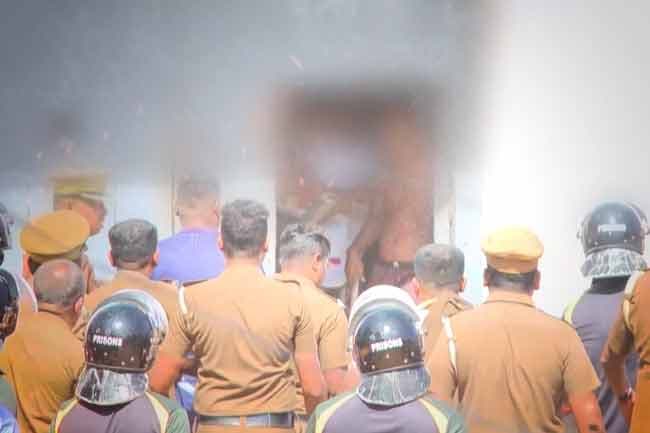
The growing crisis in Sri Lanka’s prisons, marked by loss of life and the destruction of public property worth millions of rupees, has drawn widespread attention across the country.
The 2012 Welikada Prison riot and the 2020 unrest at Mahara Prison can be viewed not merely as isolated prisoner clashes, but as warning signs of deeper problems within the country’s prison system.
Reports issued by commissions appointed to investigate the causes of those incidents clearly identified severe overcrowding in prisons as a major factor contributing to such problems.
The crisis resurfaced following unrest at the Negombo Prison in July, which subsequently spread to the Mahara, Magazine, Kuruwita and Pallansena prisons.
According to information on the official website of the Department of Prisons, the maximum capacity of the country’s 36 prisons is 10,500 inmates. However, as of August 1, 2026, nearly 39,400 inmates were being held in prisons across the country.
This means the current prison population is more than three times the total capacity.
The Negombo Prison has facilities for 820 inmates, but nearly 2,418 inmates were being held there when unrest broke out in July. Mahara Prison has a capacity of around 1,200, but currently holds nearly 4,078 inmates. Pallansena Prison can accommodate around 1,000 inmates but has nearly 2,000 inmates.
The situation raises a fundamental question: can prisoner rehabilitation be effectively achieved under such severe overcrowding?
Norway is widely regarded as having one of the world’s more successful prison systems. Its approach focuses not only on punishment, but also on rehabilitation, reintegration into society and the protection of human rights.
A key feature shared by successful prison systems is that inmates are housed within the capacity that prisons can reasonably accommodate.
While the systems used in Norway or Sweden cannot be directly replicated in Sri Lanka, the need for urgent reforms to reduce overcrowding, drug circulation and unrest within the country’s prison system is increasingly clear.
Therefore, the challenge should not end with appointing committees and producing reports. Sri Lanka needs to transform its prisons from places that may reinforce criminal behaviour into institutions capable of rehabilitating offenders and preparing them to return to society.