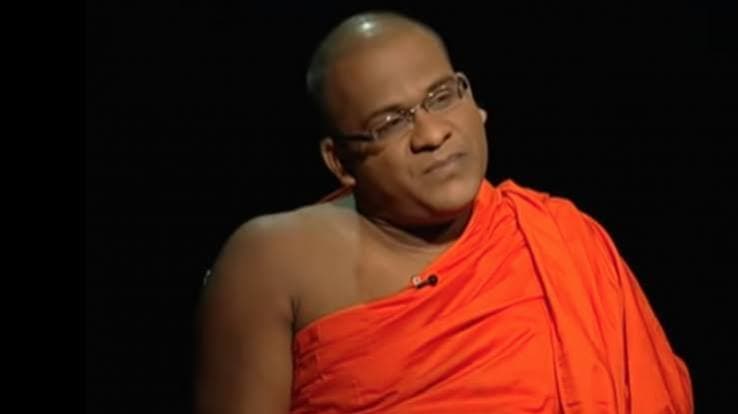
The Supreme Court’s decision to invalidate the presidential pardon granted to Galagoda Aththe Gnanasara Thera by former President Maithripala Sirisena cannot be viewed merely as a matter concerning the punishment or pardon of one individual.
It has once again brought to the forefront a long-standing issue in Sri Lankan politics concerning the scope of presidential pardon powers and executive authority.
The key question is whether powers granted to the President under the Constitution can be exercised in a manner that places them above the rule of law and the independence of the judiciary.
In the case involving Gnanasara Thera, the judicial process had already been completed. The Court of Appeal convicted him on four charges of contempt of court and sentenced him to six years of rigorous imprisonment. The Supreme Court subsequently rejected special leave to appeal against that judgment.
Accordingly, the judgment had reached finality through the ordinary judicial process. However, on 23 May 2019, former President Maithripala Sirisena granted Gnanasara Thera a presidential pardon under the power vested in the President by Article 34 of the Constitution.
The central issue is therefore not simply whether the President possessed such a power, but how that power was exercised.
In particular, the termination of a sentence imposed by a court for contempt of court through an individual executive decision raises serious questions regarding judicial independence and the finality of judicial decisions.
Another controversial presidential pardon granted during Maithripala Sirisena’s presidency was the pardon given to Jude Shramantha Jayamaha, who had been convicted in the Royal Park murder case. That pardon was also subsequently invalidated by the Supreme Court.
This means that two controversial presidential pardons granted by the same President have been challenged before and invalidated by Sri Lanka’s highest court.
The issue, therefore, should not be viewed solely as a matter concerning Maithripala Sirisena. It is fundamentally a question about the presidential pardon power itself, regardless of who occupies the presidency.
If constitutional reform is being discussed in Sri Lanka, the scope of the presidential pardon power should also be brought to the centre of that debate.
If a court independently hears a case, finds a person guilty and imposes a sentence, but a single individual holding political power can subsequently alter the outcome through executive authority, questions inevitably arise about the finality of judicial decisions and the limits of judicial independence.
Therefore, the extent to which the powers vested in the executive presidency should be restricted is an issue that requires serious consideration in the future.
Particular attention should be given to the presidential pardon power, including whether it should be removed altogether or, at minimum, subjected to strict constitutional limitations, greater transparency and judicial review.
The rule of law should not be a slogan remembered only when political power changes hands.
The key lesson arising from the Gnanasara Thera case is that the President should not stand above the law, and a presidential pardon should not stand above the law either. The ultimate authority in a country should be the law, not the discretion of an individual.