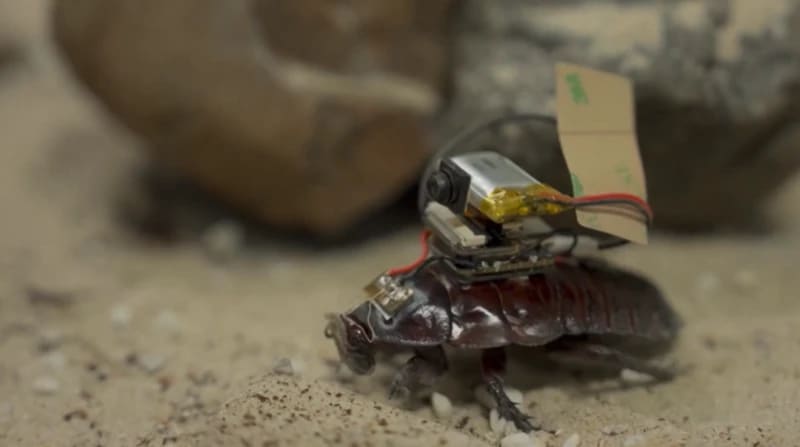
Scientists from the University of Queensland and the University of New South Wales in Australia have developed ‘cyborg’ cockroaches that could one day assist in search-and-rescue operations.
Known as ‘Paraborgs’, the insects could be used to search for people trapped in collapsed buildings and confined spaces, as well as to deliver emergency medicines, researchers say.
The researchers used giant burrowing cockroaches found in northern Queensland. Growing up to 8.5 centimetres long, they are among the heaviest cockroach species in the world.
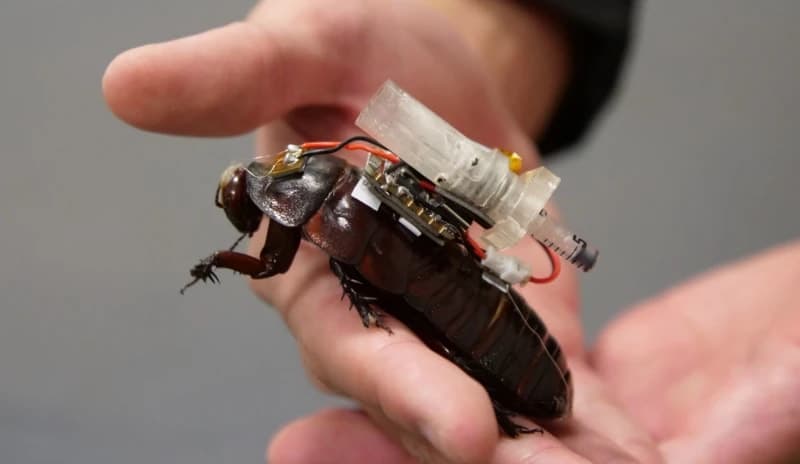
Each insect was fitted with a small backpack-like device carrying equipment such as a camera or a needle for delivering medication. Tiny electrodes implanted in the cockroaches’ bodies can transmit electrical signals to their nervous systems, allowing operators to control their movements remotely.
The technology could enable the insects to deliver medication through an attached injection device once they reach a patient.
Biorobotics engineer Thang Vo-Duy said the insects are first anaesthetised and their movement is restricted during the procedure to ensure they do not experience discomfort.
Cockroaches were selected because they can enter narrow spaces, move across difficult terrain and survive in harsh environments. They also require significantly less energy than conventional robots.
The injection technique has not yet been tested on humans. However, experiments have been conducted in controlled laboratory environments using silicone targets and pig skin.
During the laboratory tests, an ‘observer’ cockroach used a camera to locate a target, while another cockroach used an injection device to deliver medication under remote guidance.
Overall, 72% of the medication-delivery attempts were successful. When the injection was carried out from a distance of 15 centimetres from the target, the success rate increased to 95%.
Researchers believe the insects could eventually be used to reach people trapped inside collapsed buildings or caves.
They could also potentially deliver emergency medication for severe allergic reactions or snake bites while human rescue teams are still trying to reach an injured person.
However, researchers still need to address challenges including disrupted signals, dangerous terrain and ensuring that injections can be delivered safely.
Ultimately, scientists hope to deploy groups of Paraborgs in disaster zones, with some assigned to search for survivors and others equipped to carry emergency medication.
Source: Collective Newsroom for BBC
Images: The University of Queensland & Reuters